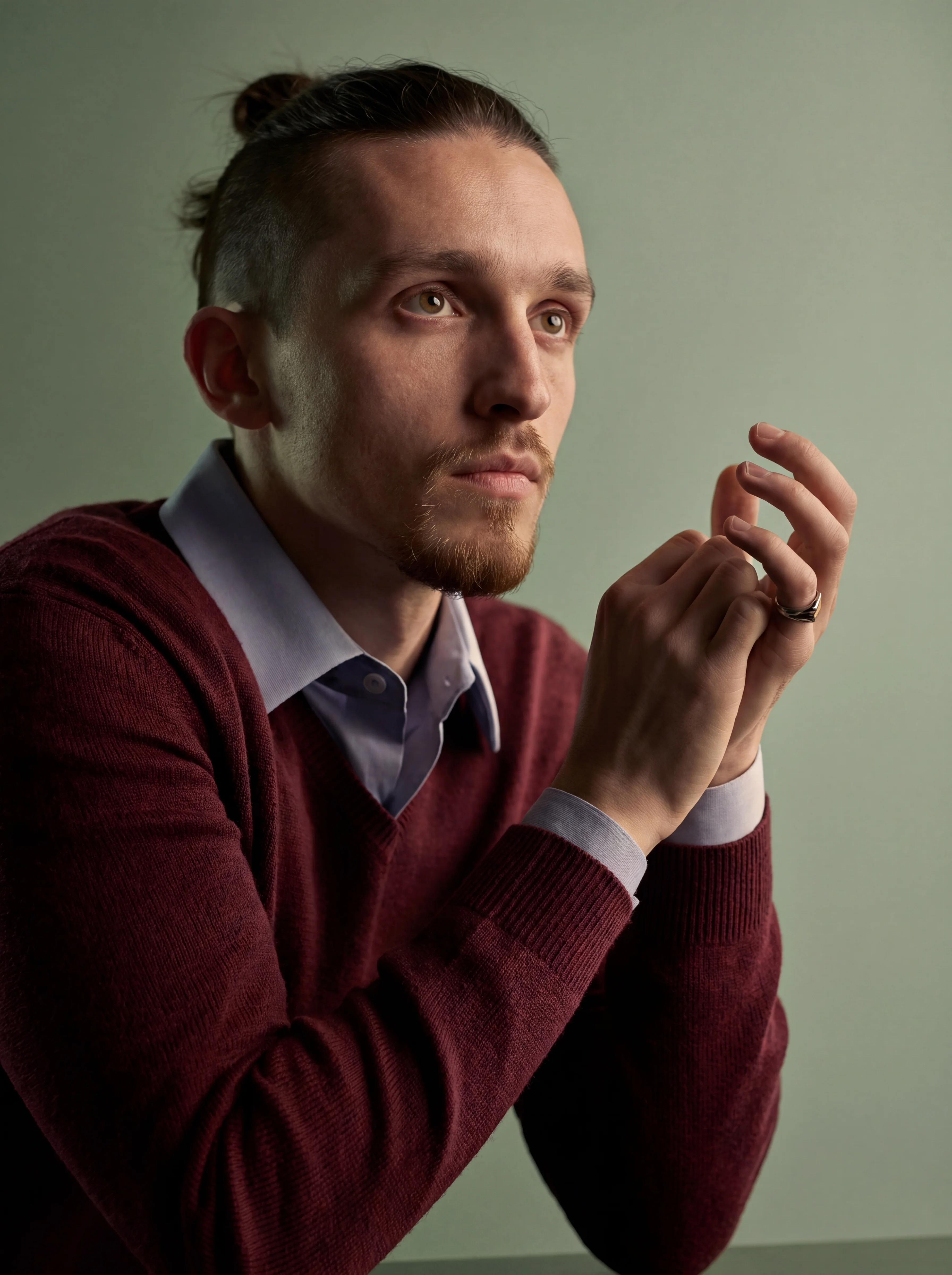
Full Story
Leo
Levs DavidovsExperience Architect
Fifteen years across creative industries have given me one persistent obsession: how form creates internal response. A game mechanic, a brand identity, a film frame — each is a construction that either provokes something real in a person, or sits quietly and goes unnoticed. I have spent my career learning how to make it provoke.
I work across disciplines because each one gave me a different angle on the same question. That range is the focus.
"The more angles you understand a system from, the closer you get to seeing it whole."
01 — The Story
Where It Started
I was born in Riga in 1996. My mother worked in a school, and from the age of five she brought me into the art classes there, drawing alongside students much older than me. Those years gave me a head start in craft I never lost. At thirteen I moved to England, into a school full of people from all over the world. Learning to read how differently they each thought sharpened an instinct I still work from. Through my teens I kept flying back to Latvia for private art classes, and by sixteen I was teaching art to younger kids on weekends. Two things arrived early and stayed with me: making things with my hands, and wanting to understand why people behave the way they do. Those two grew together naturally, the way most things worth keeping do.
"Every system carries a feeling inside it. The work is finding out what that feeling wants to be."
I studied Art and Design formally, first at Northampton College, where the course ran wide on purpose: fashion, photography and the darkroom, product design, each one teaching me to look at a single thing from many angles. Then an extended programme in Game Design and Interactive Media at Warwickshire College Group: 3D modelling, animation, concept art, game psychology, real studio projects and playtesting.
I built two games there. The first was a physics prototype with no code at all, a character climbing a tower of unstable boxes to reach the figure at the top; every fall reset the same conditions until you learned the pattern. Looking back, on my first day inside an engine I had already built a level, a goal, and a challenge. The second turned a 3D-modelled spaceship into hand-cut sprite animation. The tools were the lesson. The instinct for systems was already there.
Alongside all of it, I spent years inside typology, Jungian psychology, socionics, and narrative theory: a genuine drive to understand how human systems work and how they can be expanded. What makes a story land. What turns a rule into an experience a person remembers.
In 2020 I started a self-employed practice under the name Davydov Harmony, working across branding and web design. Understanding identity — who speaks, to whom, and what stays in memory — became a foundation I still work from.
In 2022 I designed a personality-based card game built on MBTI typology and socionics. Proof that psychological structure can drive play, shape it, give it meaning. That same year I led ten entrepreneurs through a business development programme in London. We started from a first idea. We placed first among two hundred candidates.
In 2024 I built Quest Walkers: an AR experience running through real city locations using Facebook Messenger as the game engine. Every participant completed it. No app download. No technical support required. The city became the board. The story became the logic.
That same year I co-designed Partner Image with psychologist Eugenia Khokhlatova. A therapeutic board game tested in live therapy groups. The facilitating psychologist observed an 80% improvement in therapeutic effectiveness. Real sessions. Real people. The result I am most proud of.
Since then: AI creative direction for Schwarzkopf, a UGC series, and VESPER, an AI agent I am building now.
"The projects that changed people the most were the ones that started from a genuine question about who they are."
By 2026, all of it had converged into the same question. How do you build something that makes a person feel, think, or see differently. Games, brands, media, narrative: each is a different door into that question. The discipline is the same. The domain shifts.
02 — Timeline
The Journey
- 1996 Born in Riga, Latvia.
- 2010 Moved to England.
- 2013 Graduated from Malcolm Arnold Academy.
- 2014 Level 2 Art & Design — Northampton College.
- 2015–2017 Extended Diploma in Game Design & Interactive Media, Warwickshire College Group. 3D modelling, animation, game psychology, studio playtesting. Built two student games: a no-code Unity physics prototype and a 2D shooter animated from 3D-modelled sprites.
- 2020 Started self-employed practice. Founded Davydov Harmony — branding, web design, visual identity.
- 2022 Designed first personality-based card game — MBTI Type Game (MBTI typology × socionics). Led a business development team of ten entrepreneurs from idea to launch; placed 1st in a competition of 200+ candidates.
- 2024 AR quest experience — Quest Walkers: The Snow Queen. Messenger-based gameplay across real city locations; zero friction, full completion rate. Co-designed Partner Image with psychologist Eugenia Khokhlatova. Tested in therapy groups: 80% improvement in therapeutic effectiveness.
- 2025–2026 AI creative direction: Schwarzkopf commercial series, UGC video projects. VESPER AI agent — active development.
03 — Method
How I Think
I work across several areas at once because for me they describe the same thing. A game, a brand, an ad film: each is a system in which psychological meaning is transmitted through choices of form. When I design rules for a board game, I am thinking about the same thing I think about when I choose a typeface: what internal state should this provoke, and what construction will reliably provoke it.
"Every creative decision is a hypothesis about what a person will feel. Good design is the one that gets the answer right."
My method: systems with soul. Constructions where one thing holds another, where mechanics carry emotion, and emotion fills mechanics. This works in game design, in branding, in video direction. The discipline is the same. The domain shifts.
The first question I bring to any project: what should this make a person feel, think, or do. When that answer is clear, every choice of form — tone, format, structure — falls into place. When it is still open, the work is still in progress.
The projects that interest me most start with a real conversation about what we are actually building and why. If that is where yours starts, I would enjoy hearing about it.
Want to Work
Together?
Ready to discuss a project, whether it is fully defined or still just a direction. The conversation is where most of the real work starts anyway.